Quality touches processes, people, products and systems
and collaboration with customers and suppliers
Your role and responsibilities
We would like to discuss here the typical responsibilities of the Quality Manager, and then explore how EXB Software can provide support. As a Quality Manager, you are responsible for safeguarding and improving quality within the organisation. You ensure that processes run under control, that products and services meet agreements and standards, and that deviations lead to structural improvement. You deal with quality policy, procedures, audits, complaints, corrective actions and certifications such as ISO 9001 or sector-specific standards.
Your role is organisation-wide: quality touches processes, people, products, services, systems and collaboration with customers and suppliers. EXB Software provides a platform to coordinate and connect all of these aspects.
The challenges in your daily work
In practice, you notice that quality information is often fragmented. Procedures are separate from execution, audit findings are not always followed up in time, and corrective actions fade into the background. Complaints and deviations do provide signals, but it is difficult to recognise patterns and improve structurally.
In addition, you have to demonstrate to management, auditors and customers that the quality of products, services and the organisation is under control and that your organisation learns and improves. That requires overview, coherence and reliable information.
1. Quality management (Quality)
Quality processes are often recorded in a variety of ways: procedures in process flows, records in Excel, complaints via email, audits in separate reports. As a result, it is difficult to obtain a complete picture of actual performance.
Your responsibilities
- Recording and managing quality policy, procedures and work instructions;
- Setting up and carrying out internal audits and inspections;
- Recording and following up deviations, complaints and non-conformities;
- Planning, carrying out and safeguarding corrective and preventive actions (CAPA);
- Monitoring performance through dashboards and reports;
- Supporting certifications and re-certifications.
Consequences without proper support
A lot of your time goes into searching for, combining and checking information. Audit preparation takes weeks and it is difficult to deliver reliable management information quickly.
With an integrated QHSE platform, you record audits, deviations, corrective actions and KPIs centrally and fully integrated. You have full control and insight into developments at all times.
with EXB Software as support
- A single source of truth for quality information.
- Scheduled inspections and audits.
- Immediate reports and dashboards for management and auditors.
- Clear and continuous follow-up, safeguarding and implementation of corrective actions.
- Consistently demonstrable compliance with laws and regulations.
2. Quality through structure, direction and accountability
Problem
Quality agreements, procedures and responsibilities are often recorded in a fragmented way. As a result, there is no overview and it is difficult to steer consistently and to account for things to management and auditors.
Your responsibilities
You ensure a clear structure in which roles, processes and responsibilities are clearly defined. You want insight into how the quality management system works, and control over decision-making and follow-up.
Consequences without proper support
- Unclear ownership of processes
- Inconsistent working between departments or locations
- Limited steering information for management
- Difficult audits and accountability
with EXB Software as support
EXB Software captures structure in the organisation, processes and responsibilities. Policy agreements, process flows and tasks are available centrally and up to date, so you can steer purposefully and account for things easily.
3. Reporting and analysis – Deviations, trends and steering information
Problem
Deviations, complaints and audit findings produce a lot of data, but without coherence, analysis remains time-consuming. Trends are recognised late and steering is mainly reactive.
Your responsibilities
You analyse deviations, recognise trends and provide management with reliable steering information. Only in this way can you improve purposefully and set priorities.
Consequences without proper support
- Limited insight into causes and patterns
- Reactive action after complaints or audits
- A lot of manual reporting work
- Insufficient substantiation of decisions
with EXB Software as support
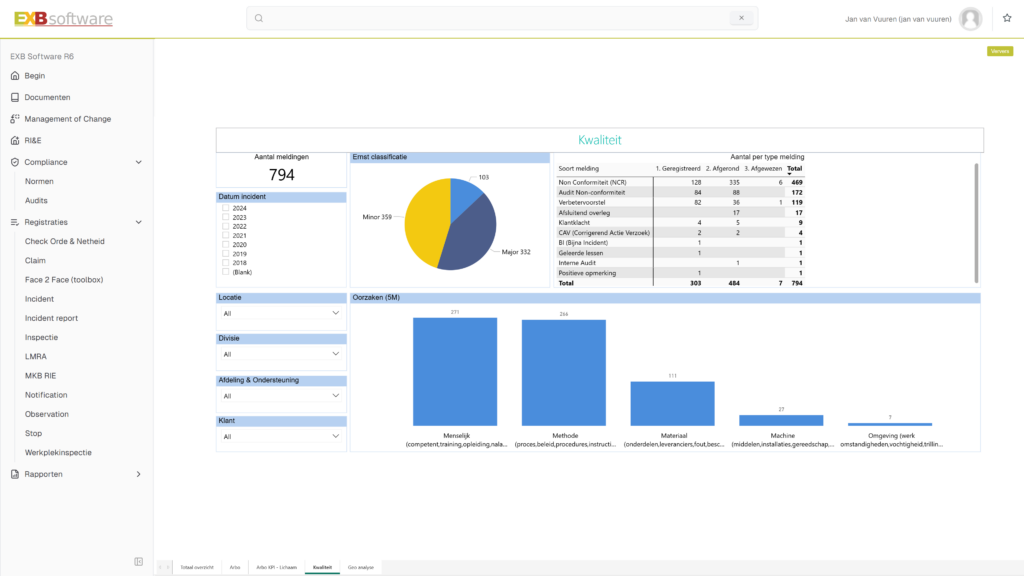
EXB Software combines records, audits and actions in dashboards and reports. You see in real time where deviations arise, how actions are progressing and where structural improvements are needed.
4. Processes and instructions – Working correctly and under control creates quality
Problem
Procedures and work instructions often do exist, but they do not always match practice. Employees work with different versions or interpret instructions differently.
Your responsibilities
You must ensure that processes are clearly defined, stay up to date and are applied correctly. Employees must know what is expected of them and have access to the right instructions.
Consequences without proper support
- Variation in how work is carried out
- Increased risk of errors and deviations
- Disputes over the correct way of working
- Quality dependent on individual experience
with EXB Software as support
With EXB Software, you link processes directly to procedures, instructions and roles. Version control and approval workflows ensure that employees always work with the right information, including via the mobile app.
5. Communication, awareness and training
Problem
The quality of services and products stands or falls with behaviour on the shop floor. If information is fragmented and employees do not know where to turn, quality remains “something that belongs to the staff department”.
Your responsibilities
- Acting as the central point of contact for quality matters.
- Informing and training employees, managers and contractors.
- Promoting awareness, a reporting culture and engagement.
- Sharing lessons from incidents, best practices and updates to policies or procedures.
- Safeguarding knowledge through procedures, instructions, e-learning and periodic repetition.
Consequences without proper support
Communication happens ad hoc via email, meetings and separate documents. You have little insight into who has read, followed or completed what.
with EXB Software as support
- You centrally publish procedures, instructions and documents and make them available on mobile.
- Employees have one fixed place for information and reports.
- You structure and plan training. You arrange certifications and available competencies.
- Competencies are visible per employee.
- The app provides procedures, instructions, documents, toolboxes, audit lists, reporting of observations and problems, feedback on submitted reports, and so on.
- You increase engagement and transparency, with fewer separate communication channels.
From firefighting to proactive quality management
The responsibilities of the Quality Manager affect the entire organisation. Without good structure and support, it is almost inevitable that you mainly work reactively: responding to incidents, product deviations, customer complaints, audit findings and questions after the fact.
With an integrated QHSE and GRC platform such as EXB Software, as a Quality Manager you can:
- Bundle information in one environment instead of in separate Excel files and folders.
- Standardise and automate processes, from report to measure.
- Be demonstrably in control of laws and regulations and of various standards.
- Proactively steer on risks and performance, instead of rejecting and repairing after the fact.
- Create more calm and overview – for yourself and for the whole organisation.

How EXB Software can help you
EXB Software is not a supplier of “yet another system”, but a partner in organisational improvement. Together we look at:
- The current processes, responsibilities and information sources.
- Where risks, ambiguities, duplications and inefficiencies lie.
- How we can put in place an integrated structure that fits your organisation.
- The new structure, which should embody a cycle of continuous improvement.
- How you can grow step by step towards demonstrable and proactive quality management.
Do you want to shift your role as Quality Manager from firefighting to focused management?
Do you really want to make a difference and take quality in your company to a higher level?
Get in touch for a conversation or a demo. We would be glad to show you how EXB Software gives you more control, calm and overview in your responsibilities as a Quality Manager.