Control over Governance, Risk Management and Compliance
Centrally organised and demonstrable
Introduction
We would like to discuss here the typical responsibilities of a GRC Coordinator, and then explain how EXB Software can provide support. In organisations, your role as a GRC Coordinator is becoming increasingly important. The GRC Coordinator works in an environment with complex processes, various sets of standards, strict laws and regulations, and constant questions from management, auditors and regulators.
Without structure, the role can quickly turn into collecting documents, maintaining Excel spreadsheets and reacting to problems after the fact. When what you really want is to look ahead. EXB Software provides the structure to organise things proactively.
Below, we discuss aspects of the GRC Coordinator role, and how an integrated platform can help you move from reactive to demonstrable and proactive risk management.
Your role in brief
A GRC Coordinator (Governance, Risk & Compliance) is responsible for:
- Setting up, managing and improving governance processes.
- Identifying, assessing and monitoring risks.
- Safeguarding compliance with internal policies, ISO standards, privacy legislation and other obligations.
- Centrally organising controls, audits, measures and reporting.
- Supporting management and directors with reliable steering information.
Behind this lies a broad range of tasks that affect the entire organisation.
1. Governance – Structure, direction and accountability
Problem
Many organisations still work with scattered documents, different versions of policies and fragmented responsibilities. As a result, there is no clear overview and it is not always evident whether agreements are being followed.
Your responsibilities as a GRC Coordinator
- Structuring governance processes and policy frameworks.
- Translating strategic objectives into concrete policies, controls and responsibilities.
- Coordinating annual plans, KPIs and governance reporting.
- Monitoring roles, authorities and responsibilities.
- Supporting management and the leadership team with well-founded, up-to-date reports.
Consequences without proper support
Reporting takes a great deal of time and there is no unified overview of policies, controls and responsibilities. This makes it difficult to steer in a demonstrable way.
with EXB Software as support
- You centrally manage policies, processes and controls.
- Reports and dashboards are immediately available.
- Governance information is uniform, current and demonstrably safeguarded.
- You create calm: one place for everything related to governance.
2. Risk management – Identifying, assessing and controlling
Problem
Risk registers are often scattered across Excel spreadsheets or updated ad hoc. As a result, there is no complete and up-to-date risk analysis at the organisational level.
Your responsibilities
- Identifying and assessing strategic, operational, financial and compliance risks.
- Setting up and monitoring risk assessments.
- Aligning risks with process owners and management.
- Monitoring measures, control tests and residual risks.
- Reporting periodically on trends and the state of control.
Consequences without proper support
Risks are discovered late or vary from one department to another. Trends are hard to identify and measures are not followed up consistently.
with EXB Software as support
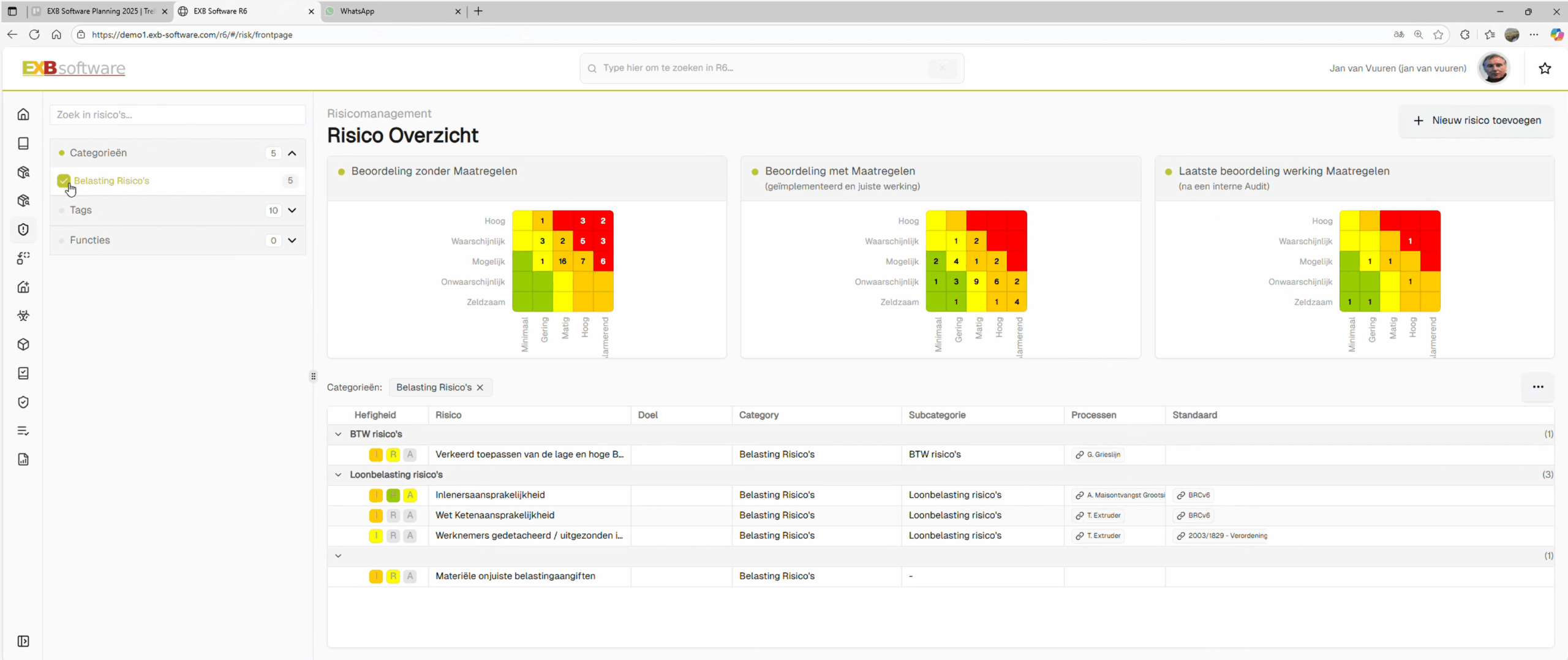
- Risks, measures and controls are held centrally in one platform.
- You have real-time insight into status, impact, priorities and owners.
- Measures are followed up and monitored automatically.
- Risk management becomes a continuous process instead of a periodic exercise.
3. Compliance – Demonstrable adherence to internal and external requirements
Problem
Compliance is complex: ISO standards, privacy legislation, technical guidelines, internal policies and customer requirements. Many organisations try to manage these requirements with scattered documents and manual checks, which is unworkable.
Your responsibilities
- Managing laws and regulations, sets of standards and internal policies.
- Drawing up compliance programmes and controls.
- Coordinating internal audits, external audits and certification.
- Monitoring compliance and recording deviations.
- Reporting to management, auditors and regulators.
Consequences without proper support
It takes an unnecessary amount of time to demonstrate that you are compliant. Information has to be collected manually from various sources, which is error-prone.
with EXB Software as support
- Standards, obligations and controls are fully integrated.
- Compliance status is immediately visible: per standard, per process, per department.
- Audits, findings and measures are followed up in a structured way.
- You can show in one go: “We are demonstrably compliant.”
4. Communication, culture and collaboration
Problem
GRC affects multiple departments. If information is fragmented or responsibilities are unclear, GRC remains something that belongs to the staff department, whereas the process should really be embraced across the whole organisation.
Your responsibilities
- Acting as the central point of contact for GRC matters.
- Explaining policies, controls, risk processes and compliance obligations.
- Promoting awareness and collaboration between teams.
- Sharing lessons learned, updates and obligations.
- Organising training, assessments and periodic meetings.
Consequences without proper support
Communication happens ad hoc, documents become fragmented and responsibilities are not followed up as standard.
with EXB Software as support
- All GRC information is held in one recognisable place.
- Teams know exactly what their responsibilities are.
- Collaborate with insight into each other’s progress.
- Inform and record at any location.
- You can see who has reviewed information.
- You automatically follow up tasks, training and obligations.
- You create transparency, engagement and a shared awareness of risks and compliance.
From reactive to proactive GRC management
The responsibilities of the GRC Coordinator are broad and affect the entire organisation. If processes are not set up centrally, it takes a great deal of time to gather information and keep track of recurring tasks.
With an integrated GRC platform such as EXB Software, you can:
- Manage governance, risks and compliance entirely centrally.
- Automate and standardise processes and controls.
- Be demonstrably compliant with internal and external requirements.
- Proactively identify and prioritise risks.
- Provide reliable steering information to management and the leadership team.
- Create more calm, overview and control in day-to-day work.
How EXB Software helps you
EXB Software is not a supplier of “yet another system”, but a partner in organisational improvement. We help you map out:
- Your current GRC processes and responsibilities.
- Bottlenecks, risks and inefficiencies.
- The best way to integrate governance, risks and compliance.
- How to grow step by step towards a demonstrable and proactive GRC landscape.
Do you want to strengthen the GRC function and gain structurally more control?
Get in touch for a conversation or a demo. We would be glad to show you how EXB Software helps you create overview, structure and certainty across governance, risks and compliance.