Quality, Safety, Health and Environment
Everything demonstrably in order
Introduction
We would like to discuss here the typical responsibilities of a QHSE Manager, and then explain how EXB Software can provide support. In organisations, a great deal of pressure rests on the shoulders of the QHSE Manager. You are responsible for quality, health, safety and environment – and you must be able to demonstrate that the organisation complies with laws and regulations, standards and internal agreements.
At the same time, you have to deal with incidents, audits, Excel spreadsheets, emails, reports and ad hoc questions from management and regulators. Without good structure, your role quickly turns into constant firefighting. EXB Software provides exactly this kind of supporting structure.
Below, we discuss aspects of the QHSE Manager role, and how EXB Software can help you move from reactive to proactive risk management.
1. Quality management (Quality)
Quality processes are often recorded in a variety of ways: procedures in sheets, records in Excel, complaints via email, audits in separate reports. As a result, it is difficult to obtain a complete picture of actual performance.
Your responsibilities
- Developing, implementing and maintaining systems to safeguard quality.
- Carrying out and guiding internal and external audits.
- Analysing deviations, complaints and quality problems.
- Initiating and monitoring corrective and preventive actions (CAPA).
- Reporting on quality indicators, trends and improvement proposals.
Consequences without proper support
A lot of your time goes into searching for, combining and checking information. Audit preparation takes weeks and it is difficult to deliver reliable management information quickly.
With an integrated QHSE platform, you record audits, deviations, corrective actions and KPIs centrally. You have full control and overview of the current situation, trends and developments at all times.
with EXB Software as support
- One reliable source for quality information.
- Scheduled inspections and audits.
- Immediate reports and dashboards for management and auditors.
- Clear and continuous follow-up, safeguarding and implementation of corrective actions.
- Consistently demonstrable compliance with laws and regulations.
2. Health and Safety (Health & Safety)
Problem
Safety policy is often well documented on paper, but practice is fragmented. The recording of incidents, accidents and near misses happens via email, forms or verbal reports.
Your responsibilities
- Drawing up and enforcing safety policy and procedures.
- Carrying out risk inventories and evaluations (RI&E) and translating them into concrete measures.
- Organising safety training, digital toolboxes and instructions.
- Investigating incidents and accidents, including analysis, reporting and follow-up.
- Monitoring incident figures, trends and the effectiveness of measures.
Consequences without proper support
Important signals are lost or come to the table too late. You work reactively a lot: after an incident, audit finding or question from the inspectorate.
with EXB Software as support
- Employees can report incidents and (near) accidents easily via the QHSE app.
- You monitor the entire workflow: from report to analysis and measures.
- Employees who report something are informed about the follow-up.
- Overviews and trends give you a grip on risks and safety performance.
- Continuous improvement (Plan-Do-Check-Act cycle)
- You can demonstrate that you are “in control” towards management and regulators.
3. Environmental management (Environment)
Problem
Environmental data is often spread across departments: facilities, production, purchasing, HR. As a result, reports for authorities and certifying bodies take a lot of time.
Your responsibilities
- Ensuring compliance with environmental legislation and standards (such as ISO 14001).
- Managing waste streams, energy consumption, emissions and other environmental indicators.
- Drawing up and maintaining environmental policy, objectives and programmes.
- Coordinating sustainability and ESG initiatives.
- Reporting to authorities, customers and other stakeholders.
Consequences without proper support
Data has to be collected, checked and re-entered manually. This increases the risk of errors and makes it difficult to steer structurally on environmental performance.
with EXB Software as support
- Map out risk and impact analyses and environmental aspects.
- Incident, deviation and non-conformity management.
- Plan and carry out audits, inspections and checks.
- Environmental and sustainability data is recorded and managed centrally.
- You link data to policy, objectives, KPIs and actions.
- Reports for permit authorities, auditors and customers are quickly available.
- You gain insight into trends and steering information for further sustainability efforts.
4. Policy, strategy and risk management
Problem
QHSE is increasingly part of integrated risk management and GRC (Governance, Risk & Compliance). Yet many organisations are still stuck in separate lists, documents and silos.
Your responsibilities
- Advising management and the leadership team on QHSE strategy and risk control.
- Drawing up annual plans, KPIs and programmes for QHSE.
- Translating laws and regulations, standards and customer requirements into concrete policy.
- Monitoring progress, results and the effectiveness of measures.
- Encouraging a culture in which safety, quality and sustainability are taken for granted.
Consequences without proper support
You spend a lot of time gathering information from various systems. It is difficult to show, in an integrated way: “These are our key risks and this is how we manage them.”
with EXB Software as support
- You bring risks, measures, incidents, audits and actions together in one platform.
- You can immediately show how risks are safeguarded, which measures are in progress, who carries them out and who is responsible.
- Overviews and dashboards support decision-making at board level.
- QHSE is demonstrably part of the broader GRC landscape.

5. Communication, awareness and training
Problem
QHSE stands or falls with behaviour on the shop floor. If information is fragmented and employees do not know where to turn, QHSE remains “something that belongs to the staff department”.
Your responsibilities
- Acting as the central point of contact for QHSE matters.
- Informing and training employees, managers and contractors.
- Promoting awareness, a reporting culture and engagement.
- Sharing lessons from incidents, best practices and updates to policies or procedures.
- Safeguarding knowledge through instructions, e-learning and periodic repetition.
Consequences without proper support
Communication happens ad hoc via email, meetings and separate documents. You have little insight into who has read, followed or completed what.
with EXB Software as support
- You centrally publish procedures, instructions and documents and make them available on mobile.
- Employees have one fixed place for information and reports.
- You structure training, certifications and authorisations, among other things with digital toolboxes.
- Competencies are visible per employee.
- The app handles everything in one place: procedures, work instructions, documents, toolboxes and audits. Easily report deviations and track the status of your reports directly.
- You increase engagement and transparency, with fewer separate communication channels.
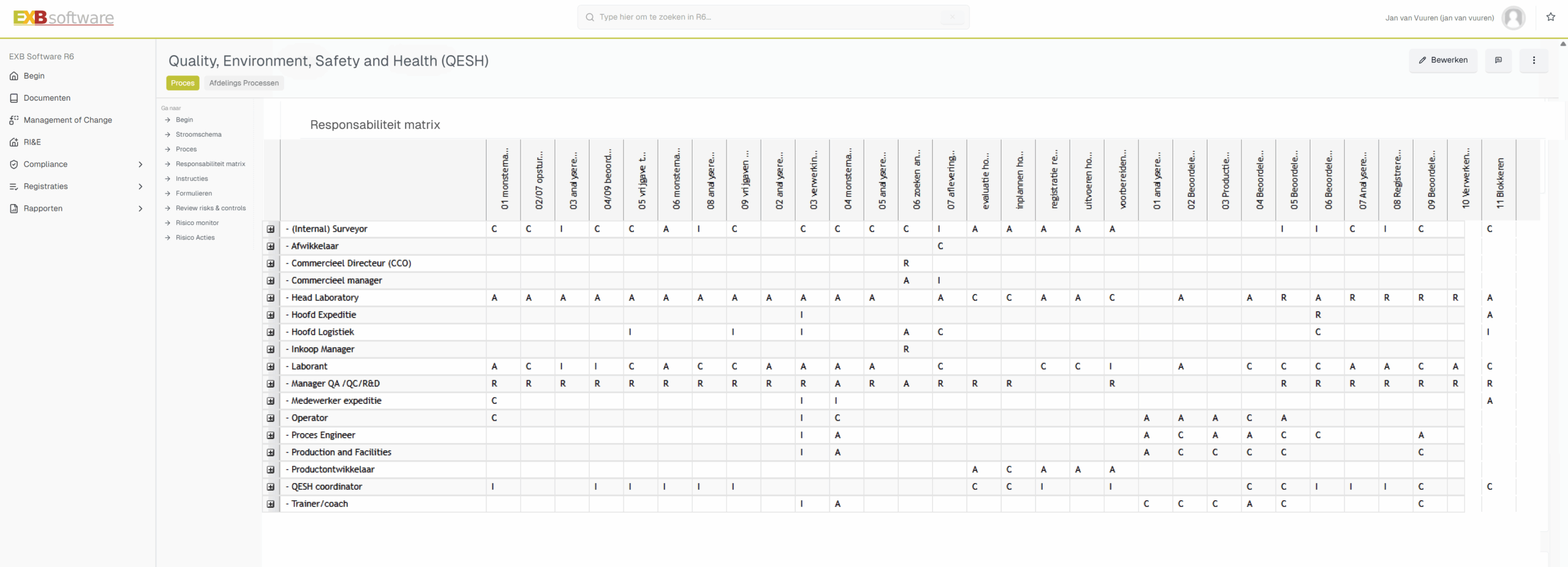
From firefighting to proactive QHSE management
The responsibilities of the QHSE Manager affect the entire organisation. Without good structure and support, it is almost inevitable that you mainly work reactively: responding to incidents, audit findings and questions after the fact.
With an integrated QHSE and GRC platform such as EXB Software, you can:
- Bundle information in one environment instead of in separate Excel files and folders.
- Standardise and automate processes, from report to measure.
- Be demonstrably compliant with laws and regulations and with ISO and NEN standards.
- Proactively steer on risks and performance, instead of repairing after the fact.
- Create more calm and overview – for yourself and for the whole organisation.
How EXB Software can help you
EXB Software is not a supplier of “yet another system”, but a partner in organisational improvement. Together we look at:
- The current QHSE processes, responsibilities and information sources.
- Where risks, duplications and inefficiencies lie.
- How we can put in place an integrated structure that fits your organisation.
- Providing a new structure that embodies a cycle of continuous improvement.
- How you can grow step by step towards demonstrable and proactive risk management.
Do you want to shift your role as QHSE Manager from firefighting to focused steering?
Do you really want to make a difference and take QHSE to a higher level?
Get in touch for a conversation or a demo. We would be glad to show you how EXB Software gives you more control, calm and overview of your QHSE responsibilities.