You are responsible for
identifying, assessing and controlling
risks
Introduction: Risk Manager
We would like to discuss here the typical responsibilities of the Risk Manager, and then explain how EXB Software can provide support. As a Risk Manager, you are responsible for identifying, assessing and controlling risks within the organisation. You operate between strategy and operations and ensure that uncertainties become visible in time and are translated into control measures. Risks affect not only safety and compliance, but also continuity, reputation and financial performance.
That requires overview, coherence and ongoing monitoring. Below, we discuss aspects of the Risk Manager role, and how EXB Software can help you move from reactive to proactive risk management.
Your role in brief
You develop and maintain the risk management process, carry out risk analyses, monitor control measures and report to management and directors. You ensure that risks do not only become visible after an incident, but are a structural part of decision-making and steering.
1. Governance – Structure, direction and accountability
Problem
Risks are often discussed ad hoc or assessed separately per department. As a result, there is no organisation-wide structure and coherence in decision-making.
Your responsibilities
You ensure a clear and uniform risk framework in which roles, responsibilities and reporting lines are clearly defined. Risk management should be part of governance, not a stand-alone process.
Consequences without proper support
- Fragmented risk information
- Ambiguity over ownership
- Limited control at board level
- Difficult accountability towards stakeholders
with EXB Software as support
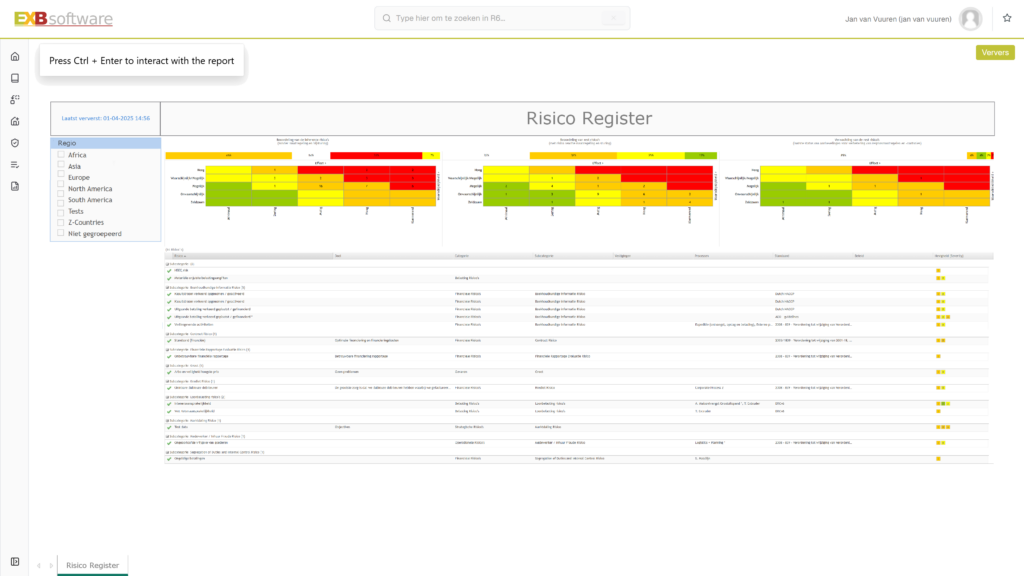
EXB Software structures risks within one integrated management system. Risks are linked to processes, departments and responsibilities, so that you can steer and report purposefully.
2. Risk management – Identifying, assessing and controlling
Problem
Risks change continuously due to market developments, legislation, technology and internal changes. Without central monitoring, risks remain incomplete or outdated.
Your responsibilities
You identify risks, assess likelihood and impact, and translate these into control measures. In addition, you monitor the effectiveness of those measures and adjust where necessary.
Consequences without proper support
- Reactive action after incidents
- Insufficient insight into priorities
- Measures without follow-up
- Limited view of the coherence between risks
with EXB Software as support
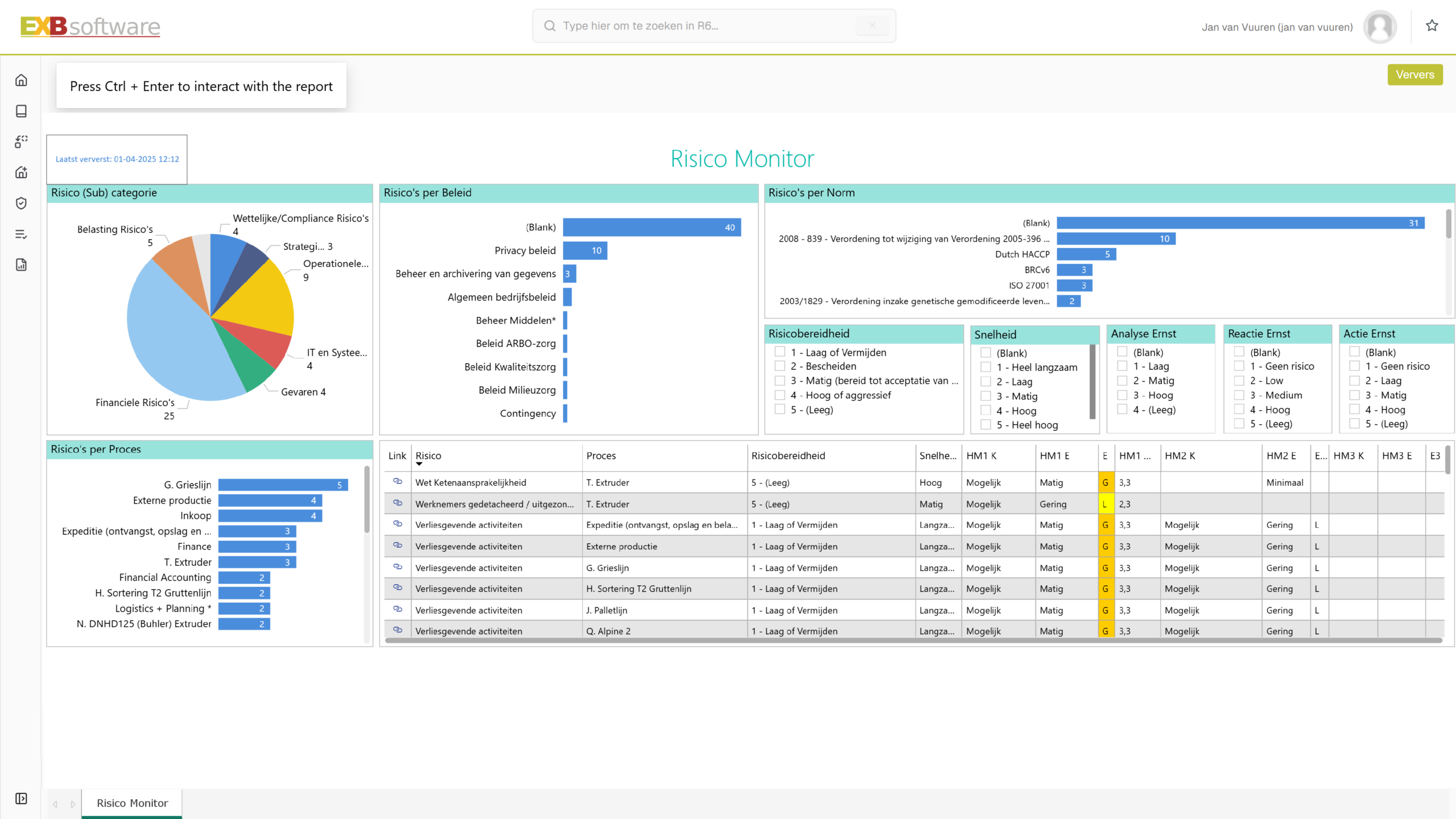
With EXB Software, you record risks in a central risk module, including assessment, measures and evaluations. Through the PDCA cycle, you monitor progress and effectiveness and have real-time insight into the current risk position.
3. Reporting and analysis – Insight and steering information
Problem
Risk reports are often compiled manually and are snapshots. This makes it difficult to recognise trends and inform management in time.
Your responsibilities
You provide reliable and up-to-date steering information for management and directors, so that they can make well-founded decisions.
Consequences without proper support
- Time-intensive reporting
- Limited transparency
- Lack of trend analysis
- Insufficient substantiation of strategic choices
with EXB Software as support
EXB Software provides dashboards and reports that make risks, measures and trends visible. This means you always have up-to-date information and can advise purposefully.
4. Communication, culture and collaboration
Problem
Risk management is sometimes seen as an administrative obligation rather than an organisation-wide responsibility.
Your responsibilities
You promote risk awareness and ensure that departments actively contribute to identifying and controlling risks. Collaboration and transparency are essential.
Consequences without proper support
- Low engagement
- Insufficient reporting of risks
- Limited learning culture
- Risks stay under the radar
with EXB Software as support
With EXB Software, you facilitate easy recording of risks and follow-up of measures. Through clear task allocation and feedback, ownership and an active risk culture emerge.
From reactive to proactive risk management
With EXB Software, you shift from reacting to incidents to structurally controlling risks. Risk management becomes an integral part of decision-making and continuous improvement.
How EXB Software can help you
EXB Software supports you as a Risk Manager in organising, carrying out and demonstrating effective risk management. You gain overview, coherence and real-time insight, so that risks become manageable and the organisation is demonstrably in control.